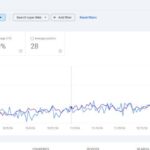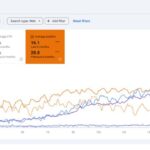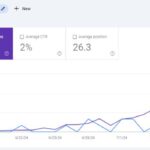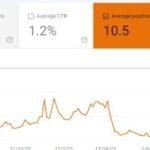
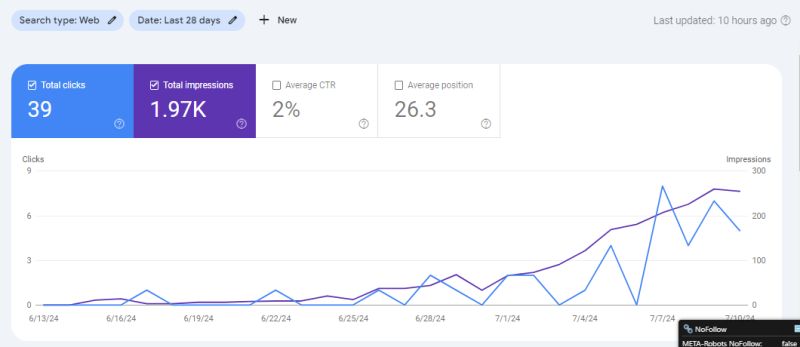
This case study documents the growth of a new blog website over the course of 30 days, during which 30 articles were published, and more than 10 secured first-page rankings on Google. The focus of the project was to demonstrate the power of Semantic SEO — a methodology that prioritizes topical relevance, entity relationships, and user intent rather than relying solely on isolated keyword targeting. The website had no prior domain authority, no backlinks, and no paid promotions. The success came from deep research, disciplined writing, and structured topic planning, proving that strategic content alone can drive visibility even on completely new websites.
Objectives
The primary goal of the project was to establish topical authority in the chosen niche within the first month. Since building backlinks takes time, effort, and external outreach, the aim was to show that Google can rank new domains purely on content quality and semantic completeness. Another key objective was to maintain a consistent publishing schedule to help the website get indexed faster and encourage Google to crawl and revisit content frequently. Lastly, the project aimed to create content that met user intent, depth of explanation, and clarity, which aligns directly with Google’s E-E-A-T principles (Experience, Expertise, Authoritativeness, Trust).
Methodology / Strategy Used
1. Semantic SEO Topic Clustering
Instead of choosing keywords randomly, a central topic was selected, and then divided into multiple supporting subtopics. Each article was strategically linked to others within the same topic group, forming a cluster of content that Google can recognize as a complete knowledge source. This structure helps Google understand what the website is about and increases the likelihood of ranking across multiple search queries. The internal linking between articles allowed the topical authority to distribute across the entire cluster, helping even newly published pages index and rank faster.
2. Keyword Research with Search Intent Prioritization
Keyword selection was influenced not just by search volume, but by search intent — understanding what the user is actually trying to achieve. Long-tail, conversational, and intent-specific keywords were prioritized because they are easier to rank and often lead to longer user engagement. Tools like Google Search Suggest, Related Searches, and People Also Ask were used to analyze real user questions. The goal was not to chase large volume keywords, but to target keywords with clear meaning, low competition, and strong intent, making ranking achievable for a new domain.
3. Content Creation Process
Every article followed a structured content layout designed to maximize readability and search relevance. The introduction immediately addressed the user’s problem, signaling to Google that the article satisfies intent. The main body was divided into H2 and H3 headings aligned with semantic variations of the topic, expanding coverage without keyword stuffing. Real examples, explanations, comparisons, and practical advice were added to make the content genuinely helpful. FAQs were included to answer search variations and gain additional visibility in “People Also Ask” results. Internal linking helped users navigate deeper into related content, increasing session duration and reducing bounce rate.
4. On-Page SEO Optimization
On-page SEO was implemented to make the content easily crawlable and meaningful for search engines. Every article used a clean URL structure, descriptive title, and keyword variations in headings and subheadings. Paragraphs were kept concise to improve readability on both desktop and mobile. Images were compressed to improve page load speed and included descriptive alt text for accessibility and context relevance. Additionally, schema markup such as FAQ Schema and Article Schema was applied to enhance visibility in rich search results. These refinements ensured both users and search engines could clearly interpret the content structure and value.
5. Consistent Work Routine & Productivity Discipline
To maintain momentum and output quality, a consistent daily schedule was followed — starting work at 3:00 AM and continuing until 10:00 AM. This quiet, distraction-free time allowed deep focus and uninterrupted content creation. Working during early hours increased productivity, reduced fatigue from external noise or commitments, and helped achieve a stable writing flow. By treating the content strategy as a professional routine rather than a casual task, consistent progress was maintained every single day, which played a major role in achieving 30 published articles in one month.
Challenges Faced
One of the biggest challenges was launching the project on a domain with zero authority. New websites typically take longer to index and rank, requiring patience and persistent optimization. Content fatigue was another issue — producing meaningful articles every day can lead to burnout if the workflow is not properly structured. To overcome this, weekly content calendars were planned in advance, ensuring clarity of what needed to be written each day. Some early articles did not rank initially, but were later updated and expanded, which led to improvements by Week 3 and Week 4. These challenges reinforced the importance of patience and refinement in SEO.
Results
After 30 days of consistent publishing and optimization, the website achieved noticeable organic traction:
- All 30 articles were indexed within 7–14 days.
- Over 10 articles ranked on the first page for their respective keywords.
- The website gained progressive traffic growth week after week.
- No backlinks were built — rankings came entirely from topical authority and semantic content depth.
The ranking improvements appeared gradual, with Week 1 focused on indexing, Week 2 seeing cluster recognition, and Weeks 3–4 showing multiple first-page entries. The results confirmed that Google rewards structured, helpful, semantically-rich content — even on new websites.
Key Takeaways
- Semantic SEO works faster than traditional keyword-based SEO for new sites.
- Building topical authority is more important than chasing backlinks early.
- Consistency and clarity of content accelerate indexing and ranking.
- Quality content that addresses real user intent is the most sustainable SEO strategy.
Conclusion
This case study proved that a new website can achieve fast, stable Google rankings without backlinks, as long as it follows a well-planned semantic content strategy. By building topic clusters, writing deeply helpful content, optimizing on-page structure, and maintaining consistent publishing discipline, ranking becomes predictable and repeatable. Semantic SEO is not just a ranking technique — it is a long-term strategy to build trust, depth, and topical authority in any niche.